Why aquaculture’s next step is fully integrated technology
02 July 2026
Aquaculture has always been an industry shaped by innovation. From advances in feed and breeding to developments in welfare and processing, producers have consistently adapted to meet the challenge of feeding a growing global population more efficiently.
As fish farmers look to improve efficiency, strengthen welfare standards and deliver greater traceability, many are turning to AI-driven systems to help manage increasingly complex operations. Yet while new technologies are emerging across every stage of the production cycle, the real opportunity may lie in how well those systems connect and work together.
Across the industry, farms often operate with multiple standalone technologies: biomass cameras, feeding systems, monitoring tools and processing software, all delivering useful insights independently. Yet disconnected systems can also create gaps in visibility, making it harder for producers to track fish accurately throughout the full lifecycle.
That challenge is becoming increasingly important as retailers, regulators and consumers place greater emphasis on accountability and welfare across seafood supply chains. The idea of full lifecycle oversight from the moment fish leave the smolt facility through to harvest and processing is quickly becoming a much bigger conversation within aquaculture.
At Ace Aquatec, we have spent more than a decade developing AI-powered systems designed to improve welfare, efficiency and operational insight across fish farming. Our early work helped pioneer one of the industry’s first biomass camera systems back in 2012. Since then, advances in AI and automated imaging have dramatically expanded what these technologies can do.
Today, our camera systems are capable of much more than estimating biomass. Our AI-enabled monitoring tools can accurately count fish entering sea pens, helping farmers reduce the guesswork that can come from relying solely on smolt purchase numbers or single-entry counts. That accuracy matters.
Even small discrepancies in stock numbers can lead to feed waste, inefficient harvest planning and unnecessary costs. Having access to reliable real-time data allows farmers to make more informed decisions throughout production while improving operational confidence at the same time.
Our AI systems are also helping farmers monitor growth trends, identify health concerns earlier and fine-tune feeding strategies around peak growth periods. In Chile, for example, monitoring projects have shown how continuous growth data can help producers adapt feeding regimes more precisely, supporting both fish performance and feed efficiency. Our A-BIOMASS® system is being used to collect weight profiles, condition scores and visible health indicators, giving farmers a clearer picture of stock quality ahead of harvest.
One of the biggest shifts, however, is happening at the point where farming and processing meet. Historically, data collected at sea sites has not always carried through seamlessly into harvesting and processing facilities. That disconnect can create inefficiencies, particularly when fish quality or weights differ from expectations during harvest. Our A-HARVESTCAM® systems are beginning to close that gap.
From net pen to harvest vessel, connected technologies can now monitor fish movement throughout the harvesting process, generating accurate real-time data as fish enter processing facilities. That information can help improve weight estimation models, support more precise grading and give processing teams a clearer understanding of the fish available for market.
For producers, our integrated AI systems can support welfare monitoring by providing visibility across the fish’s growth cycle, into harvesting and processing, helping operators maintain consistent oversight and ensure equipment is performing as intended throughout operations. As welfare expectations continue to evolve globally, the ability to verify and document welfare performance is becoming increasingly valuable for producers supplying international markets.
While AI technology continues to advance rapidly, many within the industry believe the future of aquaculture will depend less on individual innovations and more on creating connected systems that work across the entire production cycle.
For fish farmers navigating rising expectations around sustainability, welfare and traceability, our joined-up approach could prove one of the sector’s biggest advantages in the years ahead.
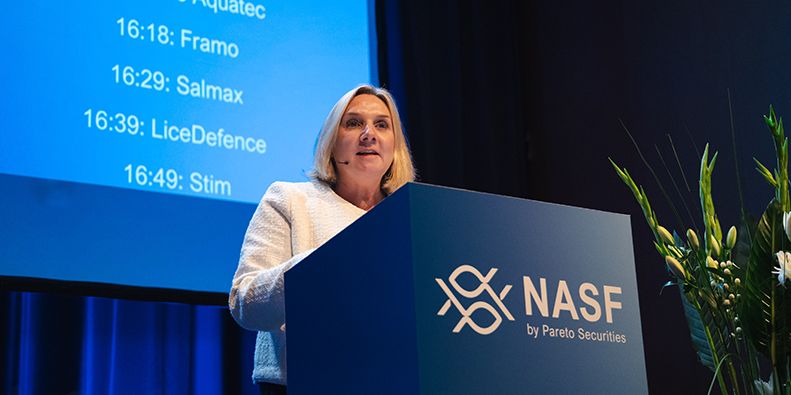
Originally presented by Tara McGregor-Woodhams, CSMO of Ace Aquatec, at the North Atlantic Seafood Forum 2026 (NASF), photo courtesy of North Atlantic Seafood Forum